How the blending of analog and digital worlds is reshaping the way we work, learn, and create
The debate used to feel urgent almost existential. Digital versus traditional. Screens versus paper. Algorithms versus intuition. For much of the early 21st century, the conversation carried an implicit assumption: one side would eventually win, and the other would fade quietly into obsolescence. That assumption turned out to be wrong. What we’re witnessing instead is something far more interesting a hybrid revolution, where the best of both worlds are converging into entirely new ways of living and working.
The False Binary We Left Behind
For decades, the narrative around technology followed a familiar arc: digital tools arrive, traditional methods resist, digital wins. We watched it happen with music (vinyl gave way to MP3s), with publishing (print newsrooms shrank as websites grew), and with photography (darkrooms emptied as digital cameras took over).
But then something unexpected happened. Vinyl came back. Independent bookshops multiplied. Film photography found a passionate new generation of enthusiasts. People didn’t abandon digital they kept streaming, kept scrolling, kept shooting on their phones. They simply refused to let go of the tactile, the analog, the deliberate.
This wasn’t nostalgia. It was something smarter: a growing recognition that different tools serve different human needs, and that the richest experiences often live at the intersection of both.
Where the Hybrid Model Is Winning
- Education
The classroom is perhaps the most visible battleground for hybrid thinking. During the pandemic, schools worldwide were forced into fully digital environments and the results revealed digital’s limits as clearly as its strengths. Students learned the convenience of recorded lectures and online resources, but struggled with focus, connection, and the kind of spontaneous collaboration that physical spaces naturally produce.
Today’s most progressive educators aren’t choosing sides. They’re designing hybrid learning environments that use digital tools for access, flexibility, and personalization while preserving in-person time for discussion, hands-on experimentation, and the irreplaceable human dimension of teaching. Research consistently shows that hybrid models, when well-designed, outperform both purely online and purely traditional approaches.
- Creative Work
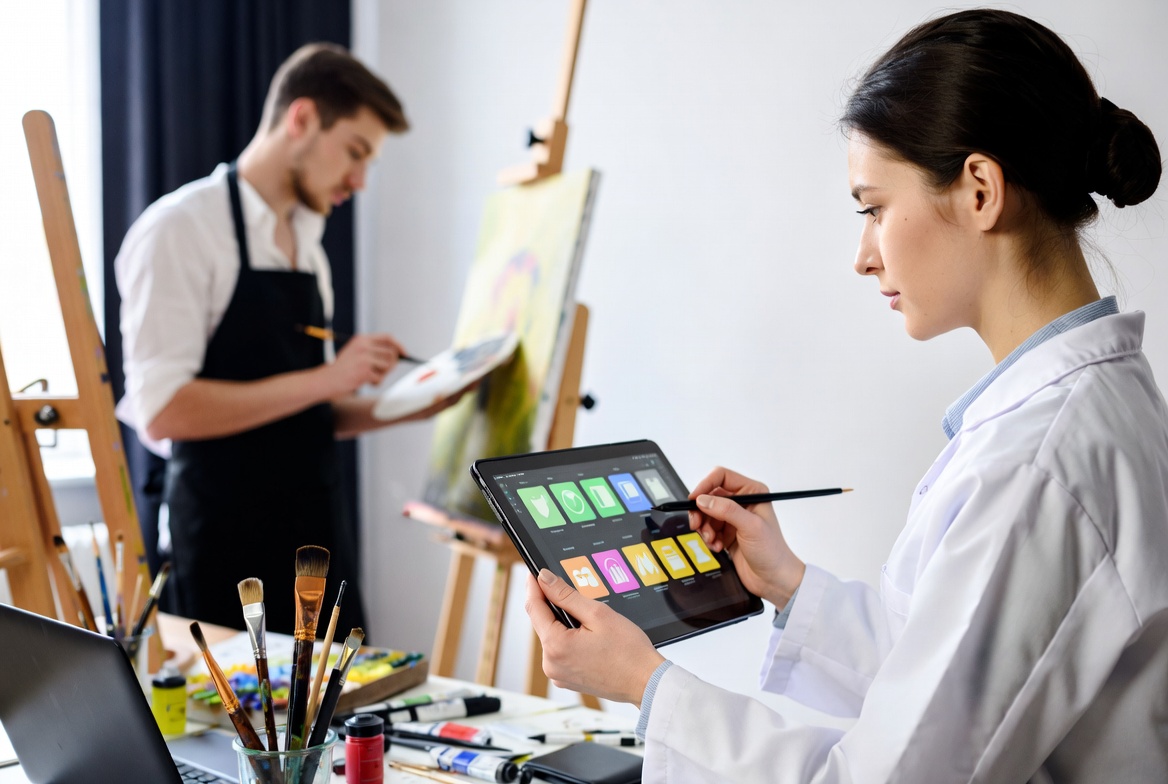
Artists, designers, and writers have perhaps embraced hybrid methods most enthusiastically. Graphic designers sketch concepts on paper before moving to screen. Architects draw freehand in the early ideation phase, then build precise digital models. Authors draft longhand in notebooks to escape the distraction of connectivity, then edit on-screen for speed and flexibility.
The tools are no longer competing they’re complementary. Each serves a different phase of the creative process, a different mode of thinking. The pencil externalizes thought in a way that feels immediate and low-stakes; the screen enables refinement, collaboration, and scale.
- Healthcare
Medicine has found hybrid applications that are genuinely life-changing. Telemedicine, accelerated by necessity during the pandemic, has expanded access to care for millions particularly in rural or underserved areas. But experienced clinicians are clear: the physical examination, the presence of a doctor in the room, the non-verbal communication between patient and practitioner these cannot be digitized. The future of healthcare isn’t telemedicine replacing hospitals; it’s telemedicine handling what it does best, while in-person care focuses on what only it can do.
- Business and Work Culture
The modern workplace may be the most widely felt expression of the hybrid revolution. Remote work proved that enormous amounts of knowledge work can be done outside a physical office. But it also revealed what offices actually do well serendipitous conversation, cultural transmission, mentorship, and the kind of creative friction that emerges when people physically share space.
Forward-thinking organizations are no longer asking “office or home?” They’re designing workflows, rituals, and spaces that intentionally blend both, allocating physical time to collaboration and digital tools to deep focus and flexibility.
Why Hybrid Wins: The Science Behind It
The hybrid model’s success isn’t accidental it maps onto something deep about how human cognition works.
Research in neuroscience has shown that handwriting engages more of the brain than typing, making it particularly effective for learning and memory consolidation. Studies on reading comprehension suggest that printed text often supports deeper processing than screens. At the same time, digital tools offer searchability, connectivity, and scale that no analog system can match.
We are, at our core, embodied creatures. We think with our hands, we learn through our senses, we connect through physical presence. Digital tools extend our reach and our speed but they don’t replace our bodies. Hybrid systems succeed because they honor both dimensions of human experience.
The Design Challenge Ahead
Embracing hybrid doesn’t mean doing everything twice. The real skill for individuals, educators, designers, and organizations is knowing when to go analog and when to go digital. That requires intentionality.
The best hybrid systems are designed with purpose: digital for distribution, access, and scale; analog for reflection, creativity, and depth. The failure mode is using digital simply because it’s newer, or clinging to traditional methods simply out of habit. The opportunity is choosing tools based on what each moment of work or learning actually demands.
Conclusion: The Best of Both Worlds
The hybrid revolution isn’t a compromise. It isn’t a reluctance to commit to the future. It’s a more sophisticated understanding of what different tools are genuinely good for and a refusal to impoverish our lives by discarding one in favor of the other.
Digital and traditional are not enemies. They never really were. The most innovative classrooms, studios, clinics, and companies of the next decade won’t be the most purely digital they’ll be the ones that have mastered the art of knowing when to pick up a pen and when to open a screen.
The revolution isn’t digital. It isn’t traditional. It’s hybrid and it’s already here.
About the Author