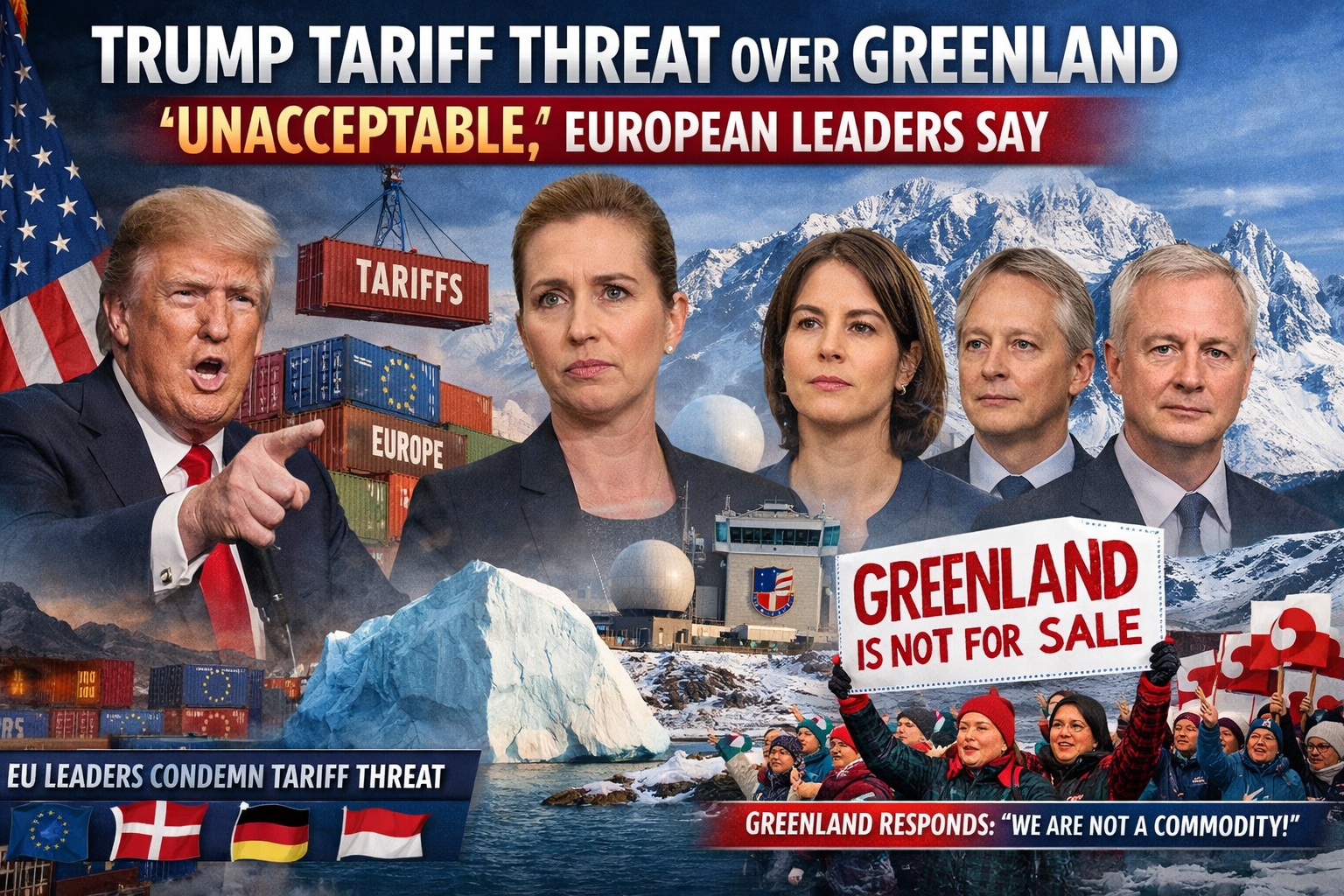
European leaders have sharply condemned former U.S. President Donald Trump’s renewed threat to impose tariffs on European goods over Denmark’s refusal to consider selling Greenland, calling the remarks “unacceptable,” “provocative,” and “damaging to transatlantic relations.”
The controversy resurfaced this week after Trump, during a campaign rally, reiterated his long-standing claim that the U.S. should “revisit economic pressure” on Europe because of Denmark’s stance in 2019 when he proposed purchasing Greenland, an autonomous territory of the Kingdom of Denmark. At the time, the suggestion sparked global backlash — and now, European officials say the renewed comments risk igniting fresh tension.
Strong Reaction From European Leaders
Danish Prime Minister Mette Frederiksen quickly responded, saying the idea of using tariffs as retaliation over Greenland is “completely unacceptable” and “detached from diplomatic reality.” She emphasized that Greenland is not for sale, nor is the sovereignty of any European territory open for negotiation.
Leaders across the EU echoed similar criticism.
-
Ursula von der Leyen, President of the European Commission, said Europe “will not be coerced economically for political leverage.”
-
Germany’s Foreign Minister, Annalena Baerbock, called Trump’s remarks “an unnecessary provocation that undermines trust between close allies.”
-
France’s economy minister, Bruno Le Maire, warned that Europe would “respond firmly” if any tariff threats evolved into policy.
Greenland’s Voice: ‘We Are Not a Commodity’
Greenlandic officials also rejected Trump’s comments. Premier Múte Bourup Egede stated that Greenland is “a land, a people, and a nation — not a commodity to be traded.” The island, home to 56,000 people, has its own self-government and has repeatedly emphasized that decisions about its future lie solely with its citizens.
Local Greenlanders, who remember Trump’s previous proposal, voiced frustration that the island is again pulled into geopolitical disputes. Recent demonstrations in Nuuk reflected strong sentiment defending Greenland’s autonomy.
Economic Stakes Behind the Rhetoric
Greenland’s strategic value has grown due to melting Arctic ice expanding access to natural resources, rare minerals, and new shipping routes. The U.S. maintains a significant military presence at Thule Air Base, reinforcing the island’s strategic importance.
Analysts say Trump’s renewed rhetoric may be aimed at:
-
Appealing to nationalist voters,
-
Pressuring NATO allies on defense spending,
-
Reinforcing his long-running belief that the U.S. carries an unfair economic burden.
However, EU trade officials have warned that tariff disputes could harm billions of dollars in transatlantic commerce.
Washington’s Response
The Biden administration distanced itself from the remarks, affirming that Greenland is a valued partner and integral part of the Kingdom of Denmark. A State Department spokesperson emphasized the U.S. commitment to “constructive cooperation in the Arctic region.”
Looking Ahead
While Trump holds no government position, his influence on political discourse remains strong. European leaders say they will monitor the situation closely but insist that the sovereignty of Greenland — or any European territory — is non-negotiable.
As Arctic politics grow increasingly competitive, Greenland’s role on the global stage will likely continue to spark debate. But for now, European leaders are united in sending a clear message: territorial bargaining backed by tariff threats has no place in modern diplomacy.