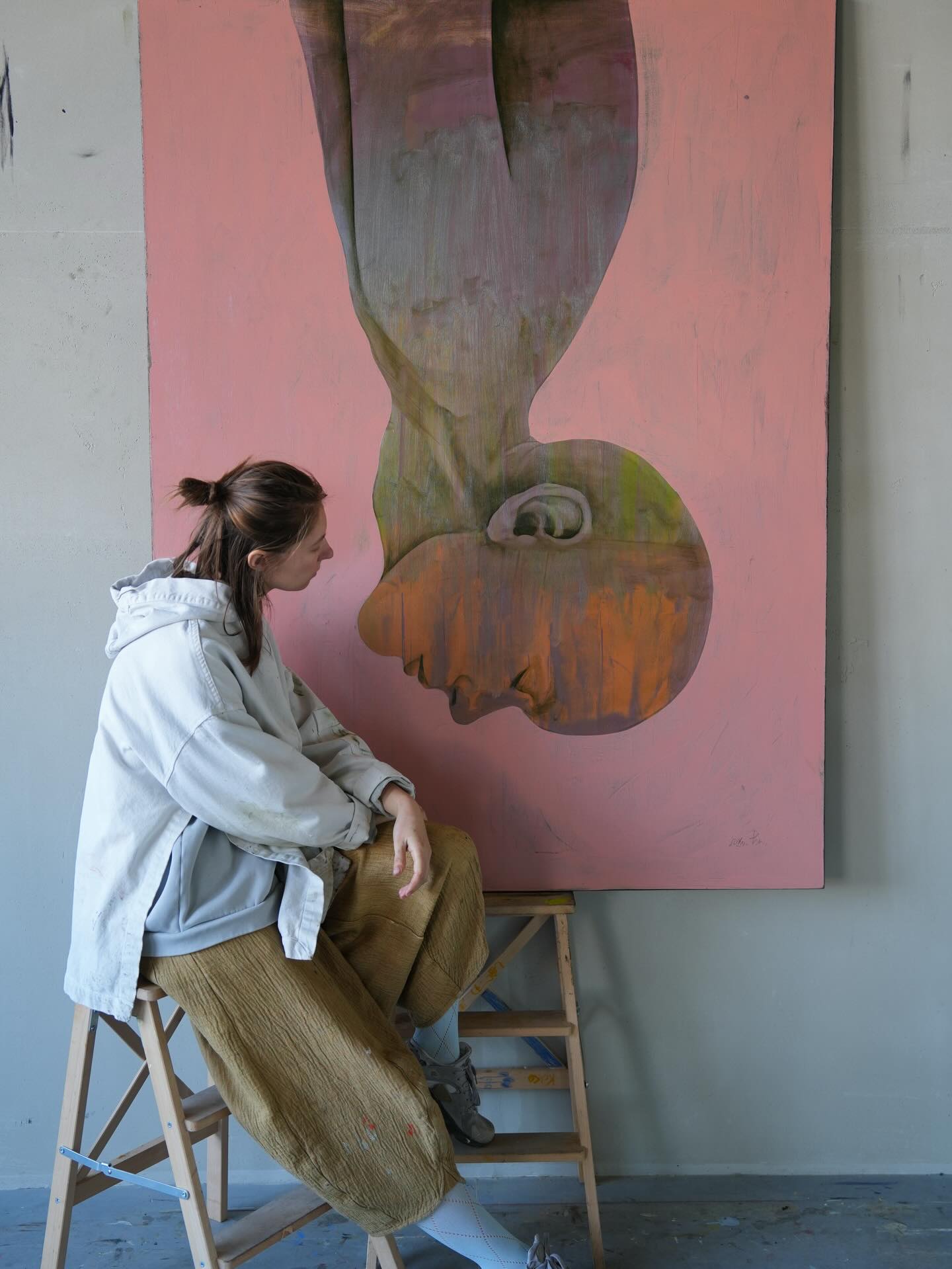
In the contemporary art world, where digital saturation often overwhelms the senses, the tactile presenceof a large-format oil painting remains a profound anchor. The artwork in question—a monumental 200x200cm canvas—presents a striking visual paradox. It features a human profile, rendered in muted, earthy tones, suspended upside down against a vast, ethereal pink void. This orientation immediately disrupts the viewer’s equilibrium, demanding a slower, more deliberate engagement with the subject matter.
“Art does not reproduce the visible; rather, it makes visible.” — This piece embodies that sentiment by visualizing the internal gravity of human consciousness.
I. The Subversion of Physical Gravity
The most arresting feature of this painting is its defiance of traditional portraiture rules. By inverting the head, the artist creates a sense of psychological descent. In classical art, the head is typically the “pinnacle” of the body, symbolizing the seat of reason and the soul, reaching toward the light. Here, the head falls into the composition from the top, suggesting a mind heavy with thought, memory, or perhaps the sheer weight of existence itself. This inversion serves as a metaphor for the “upside-down” nature of the internal life. Our thoughts are rarely linear or upright; they are often chaotic, heavy, and governed by a different set of laws than the physical world. The long, stretching neck that reaches toward the top of the frame implies a deep connection to something beyond our sight—perhaps an ancestry, a past, or a subconscious root system that we cannot fully perceive.
II. Color Theory and Emotional Resonance
The color palette is a masterclass in emotional contrast. The background is a flat, expansive field of dusty rose or salmon pink. This color often evokes vulnerability and the tenderness of human skin. By placing the subject against this monochromatic field, the artist strips away the distractions of the external world, focusing entirely on the figure’s presence. Contrasting this “warm” void is the figure itself, rendered in a complex tapestry of olive greens, deep purples, and weathered ochres. These colors suggest a body that has lived, aged, and been affected by its environment. The vertical “streaks” or dripping effects within the paint application on the face suggest tears, rain, or the simple erosion of time. It gives the skin a topographical quality, turning the face into a map of experiences rather than just a biological feature.
III. Scale as an Immersive Experience
The physical dimensions of the piece—200x200cm—are crucial to its impact. When a viewer stands before a canvas of this size, the relationship changes from observation to immersion. The profile becomes larger than life, turning the act of looking into a confrontation. The closed eyes of the subject further emphasize this; the figure is not looking back at us. It is locked in its own internal dialogue, forcing the viewer to become a silent witness to a private moment of stillness. In the context of the studio, as seen in the accompanying images, the scale highlights the physicality of the creative process. The presence of ladders and broad brushes indicates a labor-intensive journey. The artist must move their entire body to navigate the canvas, making the painting a record of physical movement as much as a visual representation.
IV. The Philosophy of Silence
In an age of constant noise, this painting is an ode to silence. The subject is still, eyes closed, appearing almost as if in a state of suspended animation or deep meditation. It invites the viewer to reflect on their own moments of quietude. The vast pink background acts as a “buffer” against the noise of the outside world, creating a safe space for contemplation. Ultimately, this work challenges our perception of what it means to be “human” in a modern context. It suggests that our true weight is not found in our physical bodies, but in the gravity of our thoughts and the depth of our inner worlds. As we gaze up at this inverted soul, we are invited to reconsider our own orientation in the world.
About the Author