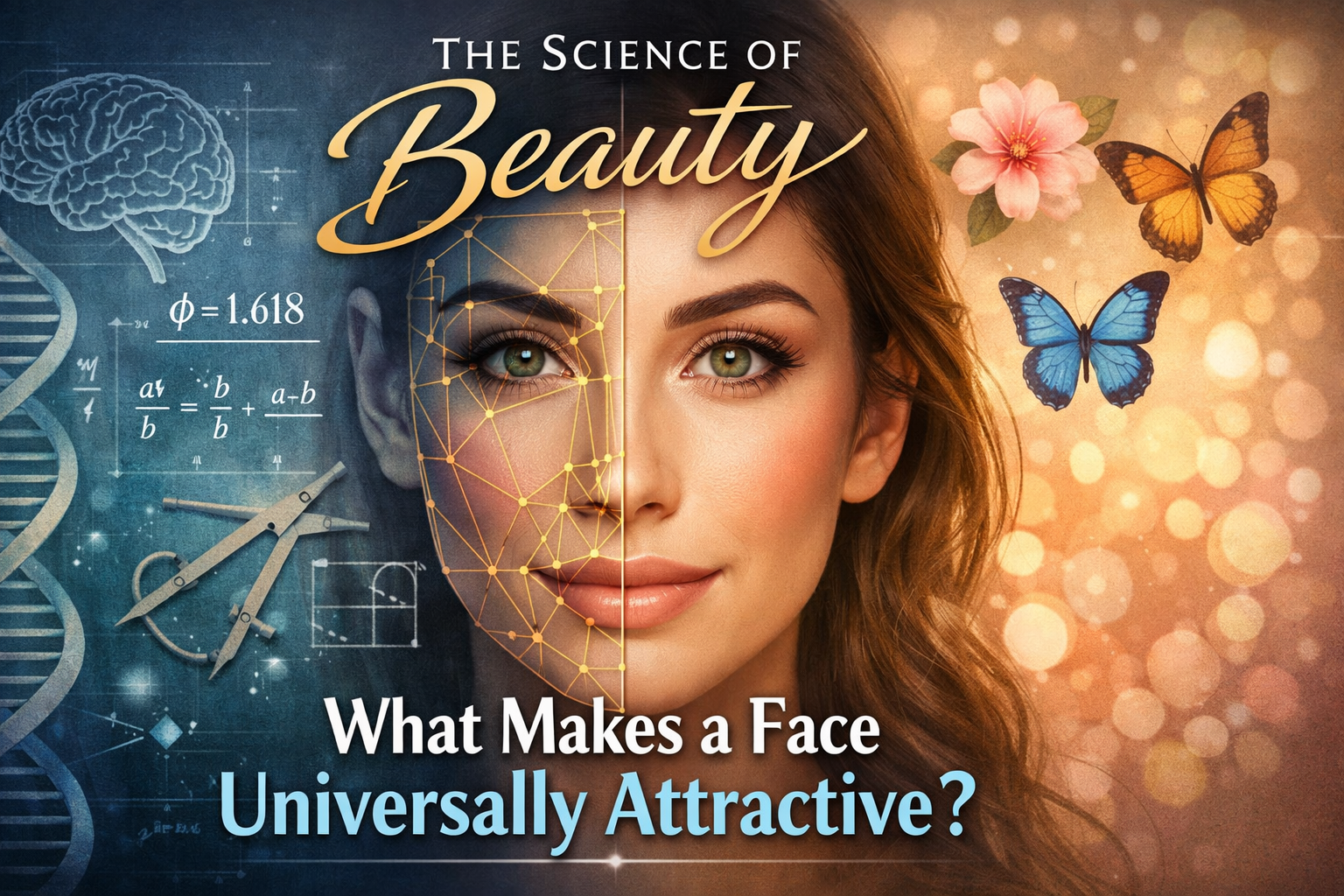
Beauty has captivated human beings since the dawn of civilization. Poets have written about it, artists have tried to capture it, and scientists have spent decades trying to understand it. But what exactly makes a face beautiful? Is beauty truly in the eye of the beholder, or are there universal standards that transcend culture, geography, and time? Modern science suggests a fascinating answer: both. While personal taste and cultural norms certainly play a role, researchers have discovered that certain facial features trigger an almost instinctual sense of attraction across the globe — and the reasons why are deeply rooted in our biology and evolution.
1. The Golden Ratio: Nature’s Blueprint for Beauty
One of the oldest and most enduring theories of beauty is the Golden Ratio, a mathematical proportion approximately equal to 1.618. Also known as “Phi,” this ratio appears throughout nature — in the spiral of a nautilus shell, the branching of trees, and the petals of a flower. Remarkably, it also shows up in the faces we find most attractive.
Research has shown that faces rated as highly attractive tend to have proportions that closely match the Golden Ratio. The distance between the eyes, the width of the nose, the length of the chin — when these measurements align with this ancient proportion, people consistently rate the face as more beautiful. Dr. Stephen Marquardt, a plastic surgeon and researcher, developed the “Mask of Beauty” based on the Golden Ratio, and found that it closely matched the faces of models, actors, and historical figures considered beautiful across cultures.
However, the Golden Ratio is not the whole story. While mathematical symmetry plays a role, human attraction is more nuanced than any single formula.
2. Facial Symmetry: A Signal of Genetic Health
If you’ve ever wondered why perfectly symmetrical faces seem so appealing, the answer lies in evolutionary biology. Facial symmetry — meaning the left and right sides of a face closely mirror each other — is one of the most consistently cited predictors of physical attractiveness across cultures.
Scientists believe we are biologically wired to find symmetrical faces attractive because symmetry signals developmental stability. During human growth, a wide variety of genetic and environmental stressors — parasites, disease, nutritional deficiencies — can disrupt the development process and cause slight asymmetries in the face. A highly symmetrical face, therefore, suggests that the individual has strong genes and a healthy immune system — making them a desirable mate from an evolutionary standpoint.
A landmark study published in the journal Nature found that people consistently rated symmetrical faces as more attractive, more healthy, and even more intelligent — regardless of where they grew up or what culture they belonged to. This cross-cultural consistency strongly suggests that our preference for symmetry is hardwired, not learned.
Interestingly, perfect symmetry alone doesn’t make a face attractive — in fact, slightly asymmetrical faces are often perceived as more interesting and “human.” Beauty, it seems, lies in near-perfection, not absolute perfection.
3. Averageness: Why ‘Average’ Faces Are Surprisingly Beautiful
Here’s a surprising finding from beauty research: average faces are considered highly attractive. This might sound counterintuitive — we tend to think of beautiful people as exceptional, not average. But in this context, “average” doesn’t mean plain. It means a face that mathematically represents the average of many faces combined.
Francis Galton, a 19th-century scientist, first discovered this phenomenon when he overlaid photographic images of multiple people and found that the composite “average” face was consistently rated as more attractive than most of the individual faces. This finding has since been replicated dozens of times with modern technology.
Why does this happen? Evolutionary psychologists suggest that average faces represent a diverse genetic profile. A face that blends the features of many people suggests a broad genetic mix — which reduces the likelihood of harmful recessive genetic disorders. In other words, our brains are attracted to average faces because they signal genetic diversity and reproductive health.
That said, the most attractive faces in studies are not simply average — they combine averageness with a few exaggerated features that signal health or hormonal strength. Which brings us to our next point.
4. Sexual Dimorphism: The Role of Hormones in Facial Attractiveness
Another powerful driver of facial attractiveness is sexual dimorphism — the degree to which a face appears distinctly male or female. Hormones like estrogen and testosterone shape our faces during puberty, and certain hormone-driven features are consistently rated as attractive across cultures.
In women, high estrogen levels during development are associated with features like fuller lips, higher cheekbones, larger eyes relative to face size, a narrower jaw, and smoother skin. These features signal fertility and reproductive health, which may explain why they are so widely considered beautiful. Research by evolutionary psychologist David Perrett at the University of St. Andrews confirmed that faces morphed to appear more feminine — with these estrogen-linked traits — were rated as more attractive by participants from multiple countries.
Interestingly, women’s preferences for masculinity in male faces are not always consistent — they can shift depending on where a woman is in her menstrual cycle, her own level of health, and the social stability of her environment. This suggests that beauty perception is not completely fixed but is influenced by biological states and circumstances.
5. Skin Quality: The Universal Beauty Signal
While much beauty research focuses on facial structure, studies show that skin quality may be one of the most powerful and universally recognized indicators of attractiveness. Clear, smooth, evenly-toned skin with good texture signals youth, health, and freedom from disease — and this signal is recognized across virtually all cultures.
A 2009 study from the University of Nottingham found that skin tone evenness was a stronger predictor of perceived attractiveness than bone structure in some cases. Participants from Europe and Africa both ranked faces with clearer, more even skin as more attractive — regardless of the actual facial features. This cross-cultural finding underscores just how powerful a beauty signal healthy skin is.
This is likely why the global beauty industry spends billions annually on skincare products. From an evolutionary standpoint, good skin signals that a person is healthy, well-nourished, and free from parasites or illness — all qualities that make them a valuable partner.
6. The Role of Culture and Media in Shaping Beauty Standards
While evolutionary biology explains much of what we find universally attractive, culture and media play a powerful role in shaping beauty ideals within specific societies. What is considered the “ideal” body type, skin tone, hair texture, or facial feature can vary significantly across countries and time periods.
In the Renaissance, fuller, more rounded body types were celebrated as the pinnacle of female beauty. In the 1960s, the slender, androgynous look became fashionable. Today, a more curvaceous, athletic figure dominates mainstream media. These shifting standards show that while certain biological preferences are fixed, cultural context has enormous power to redefine, expand, or even contradict our baseline evolutionary instincts.
Social media has further accelerated this phenomenon, with platforms like Instagram and TikTok creating rapidly shifting micro-trends in beauty aesthetics — from the “fox eye” look to “skin cycling” routines. The global reach of these platforms means beauty trends can now spread across cultures faster than ever before, both homogenizing and diversifying beauty standards simultaneously.
7. Beyond the Face: Familiarity, Personality & the Halo Effect
Science also tells us that beauty is not solely about what we look like — it’s deeply shaped by what we know and feel about a person. The “halo effect” is a well-documented psychological phenomenon where people who are perceived as attractive are also assumed to be more intelligent, more trustworthy, and more successful, even with no evidence to support these assumptions.
Conversely, personality can alter perceived physical attractiveness. Research from the University of Liverpool found that when participants were told a person had a positive, warm personality, they rated that person’s face as more physically attractive than when told the same person had a cold or negative personality. Familiarity also plays a role: the more we see a face, the more attractive we tend to find it — a concept known as the “mere exposure effect.”
This is perhaps the most hopeful finding in beauty science: attractiveness is not simply a fixed feature you either have or don’t. It can grow with familiarity, warmth, confidence, and connection.
Conclusion: The Beautiful Complexity of Beauty
The science of beauty is far richer and more complex than any single theory can capture. At its core, human facial attractiveness is shaped by evolutionary biology — we are drawn to faces that signal health, genetic diversity, and reproductive fitness. Mathematical proportions like the Golden Ratio, facial symmetry, averageness, and hormone-linked features all contribute to what we perceive as beautiful.
But beauty is never purely biological. Culture, media, personal history, and psychological factors layer onto these evolutionary foundations, creating the rich and diverse tapestry of what different people — and different societies — find beautiful. The fact that personality and familiarity can enhance physical attractiveness reminds us that beauty is ultimately a dynamic, living perception, not a fixed score.
Perhaps the most profound insight from science is this: beauty evolved not as a superficial quality, but as a meaningful signal of life, health, and vitality. When we find a face beautiful, we are, on some level, responding to the miracle of a healthy human being. And that, in itself, is a beautiful thing.
KEY TAKEAWAYS
- Facial symmetry signals genetic health and developmental stability.
- The Golden Ratio (1.618) appears in faces rated as universally beautiful.
- Average faces are attractive because they signal genetic diversity.
- Skin quality may be a stronger beauty signal than bone structure.
- Personality and familiarity can significantly increase perceived attractiveness.
- Cultural standards and social media shape beauty ideals beyond biology.